


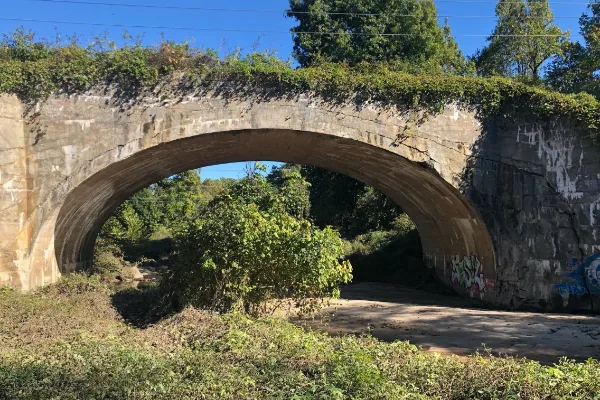
Ever since October 2015, when former Virginia Governor Terry McAuliffe cut the ribbon at its opening, the Virginia Capital Trail has been an outdoor sanctuary to Henrico residents and tourists alike. As the first truly regional trail in Central Virginia, this dedicated, multi-use paved pathway traverses 51.7 miles from Richmond to Jamestown and courses through the jurisdictions of Henrico, Richmond, James City, and Charles City.
Virginia Capital Trail really is a scenic marvel – and not just for avid cyclists and outdoor enthusiasts. The world-class trail is pedestrian friendly and wheelchair accessible. It’s peppered with interpretive sites and information kiosks. Parks like Dorey Park and Recreation Center, local hangouts like Ronnie’s BBQ, and historically significant sites like New Market Heights are a short walk or quick coast away. Travelers soak in the arresting overlooks, waterways, and vistas. The trail is so beloved that some portions of the 12.2-mile stretch of the Henrico segment see traffic in the hundreds of thousands.
“The Virginia Capital Trail shows what a well-designed trail has to offer with respect to recreation, community building, placemaking, tourism, economic development, and alternative transportation,” said Todd Eure, the assistant director of Henrico’s Department of Public Works.
Eure is not alone in his admiration; the trail is award winning. It garnered the Urban Land Institute’s (ULI) Lingerfelt Award for Best Overall Project, the ULI’s award for Best Community Impact, and Virginia Commonwealth University’s Excellence in Virginia Government Public-Private Partnership Award in 2016. In 2017, the trail was recognized with Scenic Virginia’s Scenic Tourism Award.
A Needed Escape
When COVID-19 hit, the beloved outdoor retreat became an even greater source of solace, health, and happiness. As more people socially distanced and self-quarantined, they sought out the Virginia Capital Trail as a natural escape. In March, usage increased by 65%; in May, it was up by 77% when compared to the same time last year. The Four Mile Creek section located near Henrico’s Dorey Park saw a 62% increase in patronage.
The Virginia Capital Trail Foundation, the organization committed to protecting, promoting, and enhancing the trail, has not let the pandemic encourage public enjoyment at the sacrifice of community health. It instituted COVID-19 safety guidelines and adjusted popular events. The Dominion Energy Cap2Cap, a yearly fundraising event that has ride challenges up to 100 miles, was held virtually this year. And as the Henrico community continues to navigate through the pandemic, socially distant events continue. Next month, runners and walkers can participate in a 10-mile or 5K race. In November, the trail will play host to a portion of the Richmond Marathon.
An Economic Boost
But it’s not just fitness fans who are thriving along the trail. The site supports 99 full-time jobs. Plus, entrepreneurs, residents, and business owners are feeling the positive impact of the natural attraction as well.
The University of Richmond, in collaboration with the Institute for Service Research, conducted an economic impact analysis for fiscal year 2018-2019 that measured economic activity in the trail region in and around Virginia. They found that the trail contributed approximately $8.9 million in economic activity and $5.3 million in value-added effects. Almost 95% of that economic activity happened within 50 miles of the Virginia Capital Trail.
“The area around the trail near the [Richmond-Henrico] border is booming with new commercial and residential development,” explained Eure. “As you head east along the trail into Varina, the area has a much more rural feel and look with sparse development. [Henrico] is very sensitive to preserving this rural character as much as possible.”
Cycling Gets Kul
Marna Bales, owner of Kul Wheels, an electric bike tour, rental, and sales shop in Henrico, is one such business owner who is benefitting from operating near the trail. Back in 2015, she, along with several business partners, got the company into gear. Their idea was spawned from a get-together while on vacation in Austin, Texas. Bales and friends booked an electric bike rental on a 102-degree day and were shocked at breezing through the ride.
Upon returning to Virginia, Bales wanted to experience the newly opened Virginia Capital Trail but found it challenging on a traditional bike. Looking around, she saw a segment of cyclists who might be on her same page, and a business idea was born. Originally, Bales had her battery-powered, eco-friendly bikes in storage and would meet customers to deliver them. As demand grew, she looked to lease a shop space along the trail. Last year, she found the perfect site at 1106 New Market Road.
“Everyone in Varina has been so welcoming and friendly,” said Bales.
Unfortunately, COVID-19 stalled plans for a spring grand opening, but the pandemic did not halt Bales’ good spirits. She adjusted to state guidelines, procedures, and protocols, and paused tours while focusing on pre-booked rentals and sales – which have skyrocketed. Due to proximity to the trail and increased demand brought on by the pandemic, bike orders have been back ordered as far back as May. Currently, Kul Wheels offers four different bike brands for purchase, ranging from road bikes to beach cruisers to cargo bikes, as well as accessories. The business is also happy to offer free air to any cyclist who drops by.
“[Henrico] has so many great places and stories to tell,” said Bales. “We’re just really excited to be able to help the fellow bikers.”
A New Route
In his position at Henrico’s Department of Public Works, Eure serves as the primary point of contact for the Virginia Capital Trail while leading the effort to construct a new line called the Trolley Trail. He thinks it has great potential to capitalize on the original trail’s success.
Currently under construction, the Trolley Trail utilizes the old Ashland-to-Richmond Trolley Line alignment, which runs from north to south, and will connect to the Virginia Capital Trail, which runs from east to west. What started as an idea for a 16- or 17-mile trail that would end in downtown Richmond has transformed into a 41-mile paved trail to historic Petersburg.
Henrico is fortunate to have officials like Eure, whose tireless work is energized with a passion for effecting change for the good of the community. He has the heart of an architect, the mind of an engineer, and the enthusiasm of an avid cyclist.
“Every time I travel somewhere, I ride trails and think about improvements,” said Eure. “I study the nuances of design that most might not think about. For instance, low racer [recumbent bikes] don’t turn very quickly. I saw someone training on one of those on the Capital Trail. We have sections of the trail that are coming down steeply. On the bottom of the hill, there’s a curve. And we need to take into account all users in our design.”
The goal is to complete the Henrico portion of the Trolley Trail within the next five to six years. Eure is confident that it will be a “world-class facility that will help share the history and legacy of the old Ashland Trolley Line” for years to come.
The Road Ahead
On October 2nd, the Virginia Capital Trail marked its fifth anniversary. In a month-long birthday celebration, participants are invited to join exciting outdoor activities, earn virtual badges, and learn cool facts about the trail by exploring new points of interest.
Eure thinks that when we make it through the challenges of COVID-19, the community’s love of the outdoors will endure. He and his department are working on the design and construction of more connecting trails and sidewalks to make it easier to access the Virginia Capital Trail. In addition, he’s in talks with the National Park Service to better synergize with properties that it owns.
“Once the pandemic ends, people will still understand the joy of going out for a run,” said Eure. “It’s our responsibility that we give them safe facilities to use when they do.”